Resume - A Cross-platform Resume/CV Service
"Resume" redefined profile creation as a structuring problem: how to turn lived career history into data that both people and machines can work with.
Contribution
Product Design
Company
Recruit
Year
2022
Project Overview
Team: Product owner, 2 PdMs, 2 Product Designers, 10+ Engineers
Why this mattered
Recruit Holdings operates multiple job search services with diverse markets in Japan:
• Rikunavi: NewGrad job site
• Rikunavi Next: Comprehensive job site
• Townwork: Part-time and temporary job site
• Recruit Agent: Recruitment agency service
• Recruit Direct Scout: Scout-based job change site for high-level professionals
• etc…

Across those services, users were repeatedly asked to recreate the same career history in different formats.
"One ID & One resume" was not only about consolidation. It was about defining a shared resume layer that could move across products and support better matching.

What needed to change
At the system level
• Create one resume layer that could serve products with very different needs
• Structure career history in a way AI systems could reliably interpret
• Improve search and matching for both job seekers and employers
At the interaction level
• Reduce the burden of having to translate a career into formal resume language
Design Challenges
Challenge ❶: Reducing the effort of structured input
What broke:
The product asked users to convert messy, specific work histories into AI-readable structures spanning thousands of occupations and skill tags.
The interface was technically complete, but cognitively expensive.

What we changed:
Prototype V1 (Linear Q&A):
A strict one-question-per-screen flow kept the system orderly, but it made the work feel long and narrow. Users could finish it, yet many felt it flattened the depth of their experience.
Final version (Categorized Tag UI):
The redesign moved away from linear questioning and toward categorized skill selection, so users could recognize their experience before having to describe it.
Challenge ❷: Starting at the data model, not the UI
What broke:
Testing showed the real issue was not just search UI. People could not find themselves in the occupation model at all.
What we changed:
Rather than polishing the interface around a broken taxonomy, I worked with Product Managers to restructure the taxonomy itself.
IT > Engineer > Backend > Server-side
IT > Engineer > System Engineer > Web/open
IT > Server-side Engineer
IT > System Engineer > Web/open
Flattening the hierarchy:
We reduced the occupation taxonomy from four layers to three, so the structure matched how users actually think about their work.

Changing how search explained the system:
Autocomplete suggestions were regrouped around clearer mid-level categories, replacing noisy lists with something users could parse quickly.
Validation:
SUS testing showed a significant improvement, with ease-of-understanding rated especially highly.
Challenge ❸: Designing one resume layer for conflicting products
What broke:
Direct Scout needed depth. Townwork needed speed. A single fixed onboarding flow would fail both.
The system had to stay unified without forcing every host product into the same behavior.
What we changed:
We treated onboarding as a configurable system rather than a single flow:
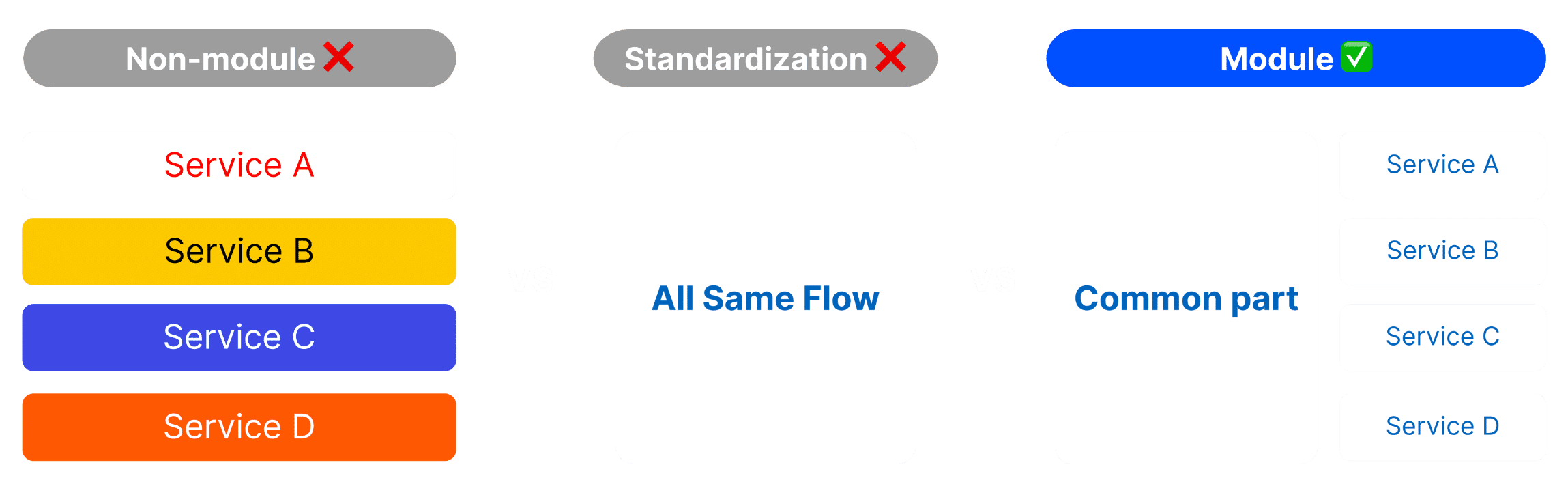
Modular system:
I helped define a reusable onboarding repository covering the full range of data modules across products.
/registration?option_items=previous_work_histories&career_summary
URL Parameter Customization:
Host products could specify what they needed through parameters, while still writing into the same underlying resume structure.
What changed
The project improved not only completion, but the quality and usefulness of the data being collected:
- Efficiency: Average resume creation time dropped significantly.
- Data Richness: Users entered significantly more skill tags on average.
- Matching Success: Candidate screening pass rates improved significantly overall, with the largest gains among younger demographics and previously incomplete profiles.

Design stance
- Resume creation got easier once it was redesigned as a translation layer for career history, not just a form.
- The biggest UX gain came from changing the taxonomy, not polishing the screen.
- Cross-platform consistency worked because the system was modular, not because the flow was universal.
- In platform work, design has to shape the structure beneath the interface.